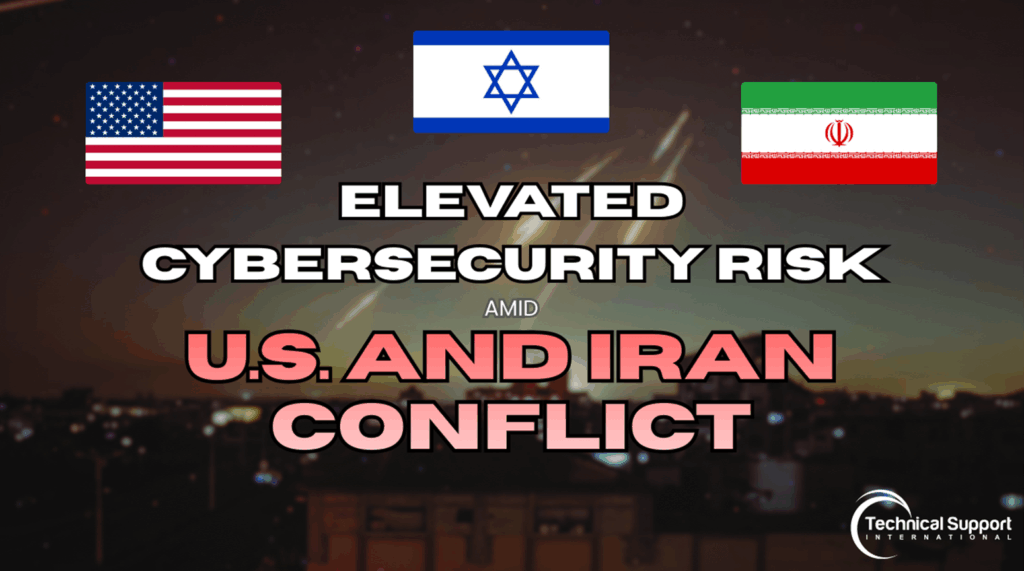
Elevated Cybersecurity Risk Amid U.S. and Iran Conflict
Christopher Souza | CEO
A cyber advisory issued by our partners at Sophos highlights an increased global cyber risk environment due to escalating geopolitical tensions involving the United States, Israel, and Iran.
Sophos assesses the current threat level as elevated, with the greatest risk occurring in the immediate to short term, ranging from days to several weeks. During periods of geopolitical instability, cyber threat activity commonly increases as nation state and opportunistic threat actors seek to exploit uncertainty and disruption.
Specifically, organizations should remain alert for a spectrum of malicious activity, including:
- Distributed Denial-of-Service (DDoS) attacks
- Website defacements
- Ransomware and wiper malware
- Hack-and-leak operations
- Credential harvesting, phishing, and password spraying campaigns
These activities are often opportunistic — driven by the desire to exploit uncertainty and operational disruption during periods of conflict.
For reference, the full Sophos advisory can be viewed here:
Sophos Cyber Advisory: Increased Cyber Risk Amid U.S.–Israel–Iran Escalation.
Why This Matters for Small Businesses & DoD Contractors
While government agencies and critical infrastructure remain primary targets, this advisory has important implications for a broader set of organizations:
- Organizations supporting the U.S. Department of Defense
- Prime contractors and subcontractors within the Defense Industrial Base (DIB)
- Companies handling Controlled Unclassified Information (CUI)
- Organizations currently pursuing or preparing for CMMC certification
Subcontractors to the DoD are especially attractive targets because they often represent a less hardened pathway into larger defense supply chains. And organizations that store, process, or transmit CUI may experience increased probing, phishing attempts, and credential-based attacks during this heightened risk period from adversaries seeking to infiltrate supply chains or steal sensitive data.
For organizations actively pursuing CMMC certification, this advisory serves as a reminder that compliance alone is not the objective. Operational cybersecurity resilience is critical. Passing an audit does not guarantee preparedness against real-world threat behavior, especially when geopolitical events drive threat actors to act opportunistically.
Supporting Your Security During Elevated Threat Conditions
As a dedicated MSSP, our role is to help minimize attack surfaces, enhance our clients’ ability to effectively detect and respond to threats, and ensure the continuity of your operations. We work to strengthen our clients’ security posture, not just their compliance posture.
In light of this advisory, we highly recommend — at a minimum — that all organizations take the proper precautions to safeguard their network environments and perform the following:
- Confirm multi-factor authentication (MFA) is enforced across all remote access and privileged accounts
- Patch all internet-facing systems and validate firmware versions
- Monitor for unusual login activity and signs of credential abuse
- Ensure backups are offline, tested, and immutable
- Review incident response and escalation procedures
These measures help reduce exposure to opportunistic attacks that are most common during periods of elevated geopolitical tension. Simple misconfigurations or outdated systems can be exploited rapidly when the threat environment shifts.
Our goal is to help organizations better protect their sensitive digital assets- including CUI, enhance operational resilience, and maintain contract eligibility in an increasingly volatile threat environment. In today’s increasingly volatile threat landscape, organizations must treat compliance as the floor — not the ceiling — of their cybersecurity strategy.
In addition to our managed security services, TSI has extensive experience guiding organizations through NIST SP 800-171 implementation and CMMC certification. We have helped multiple organizations achieve CMMC certification, and our own CMMC preparedness has been independently verified by an authorized C3PAO—reflecting the same standard required of the Defense Industrial Base.
Our approach is gap-focused and strategic. We assess your current environment, align solutions to your specific compliance objectives, leverage existing security investments, and implement measures designed to satisfy all 110 NIST SP 800-171 control requirements in a practical and defensible way.
We encourage you to visit our NIST 800-171 and CMMC pages to learn more, and to reach out directly so we can help guide you through your certification objectives.
Contact TSI Today
If you have questions regarding this advisory or would like to review your organization’s current cybersecurity posture, contact TSI today. Our team of experts is always available to help assess risk exposure, strengthen defensive controls, and ensure your business remains protected against emerging cyber threats.
TSI will continue monitoring this situation closely and will provide additional critical updates as they arise.

About Technical Support International
TSI is 38-year old cybersecurity (MSSP) and IT support (MSP) company specializing in helping DIB organizations address their NIST 800-171 and CMMC compliance obligations. As a CMMC-AB Registered Provider Organization (RPO), TSI offers a complete NIST 800-171 and CMMC support solution to help guide our clients toward a successful certification audit and provide the assurance that they’re adhering to these expansive compliance requirements.

Cyber Security Policy Starter Kit:
10 Critical Policies That Every Company Should Have in Place