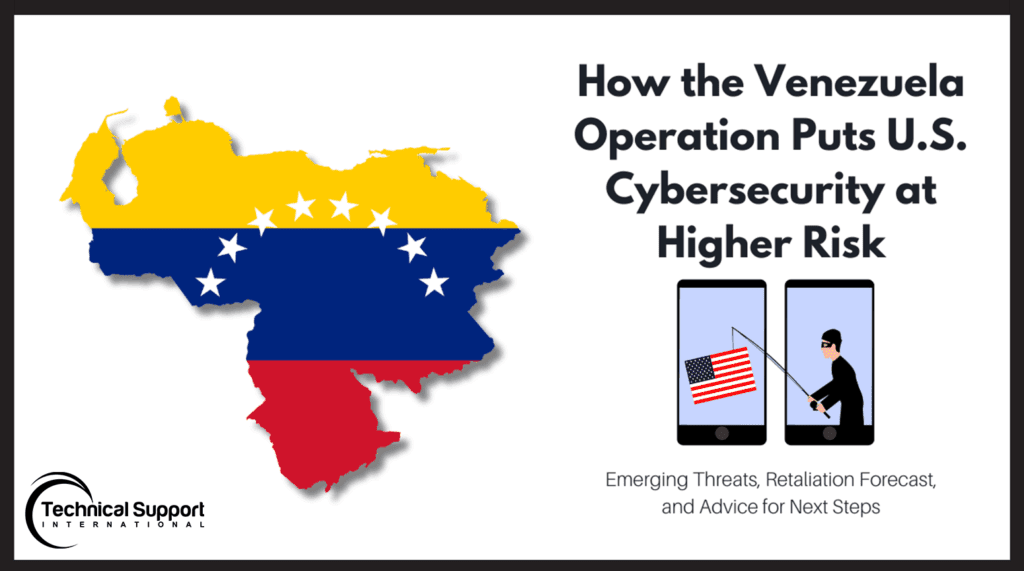
How the Venezuela Operation Puts U.S. Cybersecurity at Higher Risk
Christopher Souza | CEO
On January 3, 2026, U.S. forces conducted Operation Absolute Resolve to capture Venezuelan President Nicolás Maduro and his wife in Caracas. According to cyber professionals and public statements from U.S. leaders, cyber tools were used in advance of the raid to disrupt Venezuelan power and communications infrastructure. President Trump indicated that the city’s lights were “largely turned off due to a certain expertise that we have,” suggesting cyber effects were synchronized with the operation. It’s one of the most direct public acknowledgments of cyber capabilities being used in a high-profile military mission.
This kind of integration between conventional armed forces and cyber capabilities is not a futuristic theory. It is now part of real operations, and profound implications for how nation states and attackers approach retaliation.
A High-Risk Moment for U.S. Cybersecurity
Even though Venezuela is not considered a cyber superpower, its political and military ties to China and Russia have experts on alert. The warning comes from the Cybersecurity and Infrastructure Security Agency (CISA), whose guidance TSI closely follows as part of our CMMC and broader compliance practice. Federal officials note that the geopolitical fallout from the raid has triggered a period of “heightened vigilance,” during which state-linked cyber actors from nations such as China and Russia may increase probing and attempted attacks against U.S. critical infrastructure.
Cyber retaliation isn’t anything new. Analysts observe similar patterns after major U.S. strikes overseas, where adversaries test defenses and look for opportunities to disrupt essential systems. For example, following U.S. strikes on Iranian nuclear facilities in June 2025, Iranian-backed and affiliated hacking groups launched denial-of-service and other cyber operations against U.S. banks, defense contractors, and energy firms. Risks like these are amplified when adversary powers perceive the U.S.’s actions as crossing a line.
China, Russia, and other aligned actors could see the Venezuela intervention as justification to accelerate cyber campaigns that range from reconnaissance to full-blown disruption threatening major U.S. organizations.
Retaliation Forecast
A lot of the retaliation that goes on are things we don’t see on the news. It can blend into the background while still causing serious harm. Recent risk assessments highlight several vectors U.S. organizations should prepare for to be targeted:
- Critical Infrastructure
Energy, water, communications, and transportation networks are always prime targets for cyber-attacks. For instance, Russian-linked hackers have repeatedly disrupted Ukrainian power and telecom systems, underscoring how adversaries target essential services during geopolitical conflict. - Supply Chain and Defense Ecosystem
Contractors, suppliers, and service providers often have weaker security postures, making them attractive entry points for broader hacking campaigns. A prominent example is the 2020 SolarWinds supply chain breach, where attackers inserted malware into trusted software updates that ultimately gave access to thousands of U.S. government agencies and companies, demonstrating how upstream compromises can cascade across critical ecosystems. - Espionage and Data Theft
Intelligence gathering remains an efficient way for adversaries to gain leverage. In 2025, U.S. intelligence reported that Russian military intelligence hackers targeted Western technology and logistics firms involved in shipping aid to Ukraine, aiming to map supply chains and extract sensitive logistical data. This was a clear case of cyber espionage against defense-related networks. - Disinformation and Social Engineering Campaigns
Influence operations using fake domains, phishing, and misinformation campaigns may not shut systems down, but they undermine brand trust and create confusion. As seen repeatedly during the Russo-Ukrainian war and other geopolitical disputes, state-aligned groups have used spear-phishing and deceptive messaging campaigns to harvest credentials and spread confusion among targeted populations and organizations, blending digital influence with traditional espionage.
Emerging Threats
Beyond Venezuela, unfolding events in Iran underscore how digital and cyber dimensions of geopolitical conflicts are rapidly evolving. In response to nationwide protests and a government-imposed internet blackout, Iranian authorities have not only cut traditional internet access but also actively disrupted access to Elon Musk’s Starlink satellite internet service — a tool increasingly used by civilians to bypass shutdowns. The regime’s use of military-grade jamming equipment to interfere with Starlink signals illustrates how satellite communications can become contested cyber-adjacent battlegrounds, raising new threats to information flow, resilience, and digital infrastructure. Meanwhile, U.S. President Donald Trump has publicly discussed engaging with Musk to help restore connectivity for Iranians cut off from the global network, highlighting how corporate technologies are now intertwined with state security concerns. This convergence of state action, satellite internet, and protest movements signals a broader landscape in which hackers across the globe may exploit or target critical connectivity systems to gain geopolitical leverage.
EVERY Organization is at Risk
The U.S. intervention in Venezuela may be framed as a military and geopolitical act, but cyber risk rarely stays confined to governments or critical infrastructure. Attacks often surface first in the private sector, particularly within the DIB, where adversaries target contractors and suppliers to steal data and weaken national security. CMMC was created in direct response to this threat, as nation-state actors cost U.S. businesses hundreds of billions of dollars each year through cyber espionage, data theft, and supply-chain compromise. Strengthening private-sector cybersecurity through CMMC and similar programs is now essential not just for business resilience, but for protecting U.S. defense capabilities overall.
Most organizations are simply not staffed to constantly monitor, detect, and respond to sophisticated state-linked threats. Hackers frequently leverage smaller businesses as steppingstones into larger ecosystems. Notably, the risk is highest for organizations tied to government contract work, essential services, or complex supply chains.
No one is too small to be in an attacker’s crosshairs. Cyber incidents are increasingly widespread. Studies show the global average cost of a data breach now reaches several million dollars per incident, with U.S. organizations often exceeding $10 million in direct and indirect losses, and total global cybercrime projected to cost trillions annually by 2025. That’s why strong cybersecurity and compliance programs matter for every organization, not just large enterprises. At TSI, we help businesses strengthen their defenses and reduce risk with expert support for CMMC 2.0 compliance, NIST SP 800-171 implementation, and comprehensive cybersecurity services from vulnerability management and SIEM monitoring to incident response and end-user security training. We give organizations the frameworks and protections they need to guard against nation-state and criminal cyber threats.
Managed Security is No Longer Optional
Understanding these threats is one thing. Defending against them is another. It requires infrastructure, vigilance, and expertise.
Here is what a dedicated managed security approach brings:
- Around-the-clock threat detection and monitoring so suspicious activity does not go unnoticed.
- Incident response planning and execution to contain damage before it spreads.
- Risk assessments and vulnerability scanning to find weak spots before adversaries do.
- Network hardening, secure configuration, multi-factor authentication, and continuous logging.
At TSI, our Managed Security Services are designed specifically for organizations that must remain resilient in today’s cyber environment. With President Trump already threatening to go after Greenland, Cuba, and Iran, the United States keeps itself in international headlines, making the country a more tempting target for hackers with each passing day.
Our SOC provides continuous monitoring, correlates alerts to real-world threats, and helps craft incident response playbooks that match your company’s risk profile. We do it in a way that supports business continuity, not just alarm fatigue.
The Cost of Waiting
The cyber landscape after January 3, 2026 is not theoretical. It’s active. Retaliatory cyber activity can manifest in ways that quietly degrade performance, compromise sensitive data, or force costly remediation efforts.
Preparation is not optional. It is essential. Act now and do not become a victim of foreign conflict.
TSI Can Keep Your Company Safe
If your organization needs to strengthen its defenses against evolving state-level threats and everyday cyber risks, TSI can help.
Contact us at any time to schedule a call with our security experts. We will assess your risk profile, outline protective measures, and show you a path to stronger cyber resilience before the next threat arrives.

About Technical Support International
TSI is 37-year old cybersecurity (MSSP) and IT support (MSP) company specializing in helping DIB organizations address their NIST 800-171 and CMMC compliance obligations. As a CMMC-AB Registered Provider Organization (RPO), TSI offers a complete NIST 800-171 and CMMC support solution to help guide our clients toward a successful certification audit and provide the assurance that they’re adhering to these expansive compliance requirements.

Cyber Security Policy Starter Kit:
10 Critical Policies That Every Company Should Have in Place