CMMC Mock Assessments vs. NIST SP 800-171 Self-Assessments
Christopher Souza | CEO
For many defense contractors, one of the biggest CMMC mistakes is assuming that an internal NIST SP 800-171 self-assessment is enough to prove readiness for a C3PAO certification audit. It is not. A self-assessment is an important internal management exercise, but it is not the same as demonstrating readiness under the pressure and scrutiny of an independent third-party review.
That distinction matters even more in 2026, with the DoD’s phased implementation of CMMC having begun on November 10, 2025 and Phase 1 running through November 9, 2026, focusing primarily on Level 1 and Level 2 self-assessments. All the while, contractors are being reminded to submit annual affirmations in SPRS, and CMMC status can lapse if those affirmations are not maintained.
For executive teams and IT management, the takeaway is simple: internal confidence is not the same as certification readiness. If your organization expects to handle CUI, maintain eligibility for certain DoD opportunities, or prepare for a future Level 2 C3PAO assessment, you need more than just an internal review and it will require a realistic way to determine whether your documentation, evidence, scope, and staff will actually hold up when the formal assessment begins.
Why the Confusion?
A great deal of confusion in the market stems from recent contract-clause changes. Many contractors were used to thinking in terms of the old NIST SP 800-171 “basic self-assessment” requirement tied to prior DFARS assessment language, but that older construct is no longer applicable. This has led some organizations to conclude—incorrectly—that self-assessments no longer matter.
In reality, while the previous self-assessment requirement may have been removed from the prior clause structure, internal assessment and ongoing compliance validation remain critical. Organizations still need to progress with their NIST SP 800-171 implementation, maintain accurate artifacts, support annual affirmations where applicable, and prepare for external validation. In other words, the compliance language may have evolved, but the business need has not.
What are NIST SP 800-171 Self-Assessments Actually For?
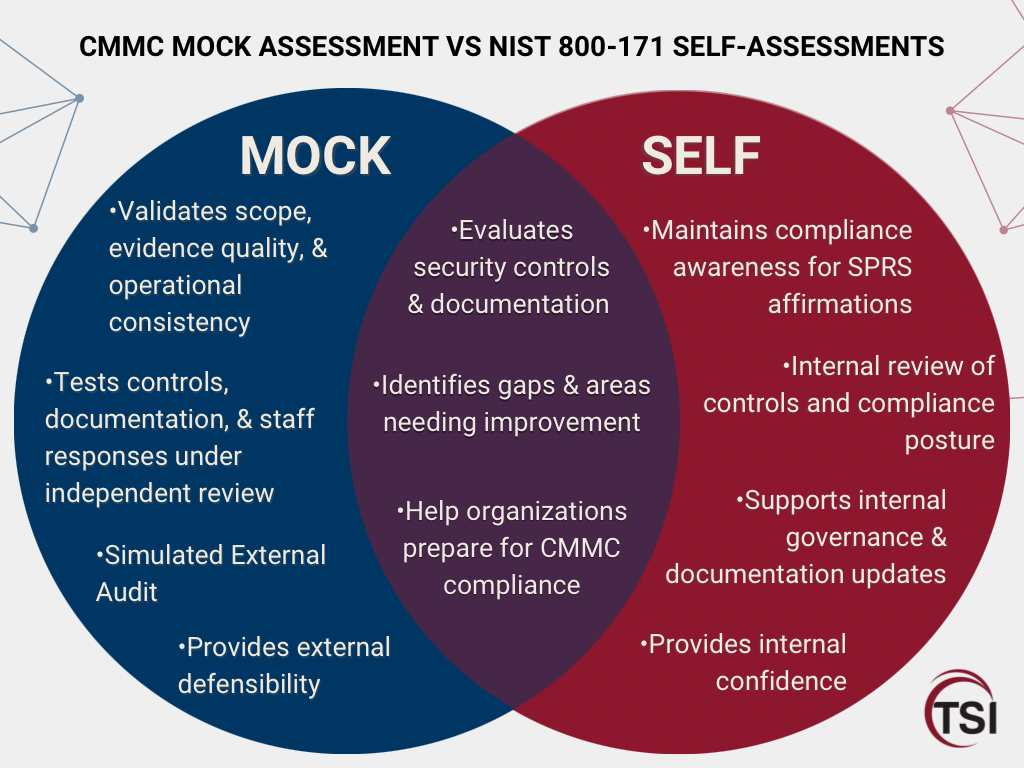
A NIST SP 800-171 self-assessment is best understood as an internal decision-making tool that helps an organization evaluate whether it believes required safeguards are in place, where gaps remain, who owns remediation, and whether key documentation such as the SSP and POA&M reflects the current environment. It is useful for governance, budgeting, remediation planning, and ongoing compliance oversight. A self-assessment tells leadership what the organization believes is true about its environment, but it does not tell leadership how an independent assessor is likely to interpret the evidence, whether the scope is defensible, or whether technical and procedural claims can be substantiated consistently in interviews and documentation review.
That is where many organizations discover they were “compliant on paper” but not truly prepared for assessment.
What’s a Mock Assessment Actually For?
A mock assessment serves a different purpose altogether. It is designed to simulate the rigor and structure of an actual C3PAO assessment so the organization can see how it is likely to perform before the official certification attempt.
This is why mock assessments are increasingly viewed as one of the most valuable readiness activities available to contractors, especially those pursuing Level 2 certification. A true mock assessment is not just casual consulting or just another internal review, it’s a structured readiness test that helps leadership understand whether the organization can clearly defend its scope, produce complete and consistent evidence, explain control implementation, and withstand the pace of a real C3PAO-led engagement.
Why the Distinction Matters
The clearest way to explain the difference is this: a self-assessment measures internal confidence, while a mock assessment measures external defensibility. One helps you manage your compliance program, while the other helps you determine whether that program is likely to survive independent scrutiny.
This is where many organizations run into trouble. They may have deployed tools, drafted policies, and made progress on NIST SP 800-171 requirements, but they have not pressure-tested whether their SSP reflects reality, whether their asset inventory supports their boundary decisions, whether service-provider responsibilities are clearly defined, or if their team can answer assessment questions consistently and a mock assessment exposes those weak points before the stakes are highest.
For leadership, this is not just a compliance distinction; it is a business-risk distinction. CMMC readiness affects contract timing, competitiveness, internal resource allocation, remediation budgets, vendor oversight, and revenue predictability. Organizations that wait too long to discover readiness problems often end up spending more money, compressing timelines, and making avoidable decisions under pressure.
Where Contractors Fail & What the Strongest Contractors Do Differently
In reality, many organizations do not fail readiness because they are doing nothing. They fail because they cannot prove enough, clearly enough, or consistently enough and the most common problems tend to involve outdated SSPs, incomplete documentation, weak evidence organization, poor scope definition, and a disconnect between operational reality and what is written down.
Those issues are often invisible during informal internal reviews that become glaringly obvious in a structured mock assessment. Executives need to know whether the organization is exposed to timing and contract risk, while IT leaders need to know whether the environment is truly assessment-ready and not just partially implemented. A mock assessment helps both groups see the same picture before a C3PAO does.
The organizations best positioned for certification do not choose between self-assessments and mock assessments. They use each for its intended purpose. This approach is strongest because it reduces surprises and provides leadership a more realistic view of risk, gives IT teams clearer remediation priorities, and helps the organization enter certification discussions with more confidence and less guesswork. In a market where more contractors are moving toward formal CMMC requirements, that kind of preparation can be the difference between controlled progress and avoidable disruption.
How TSI Helps OSCs Move from Uncertainty to Readiness
This is where TSI can add real value for organizations seeking certification. Most contractors do not need more generic information about CMMC; They need clarity on where they stand, what is missing, and what needs to happen next. They need help evaluating their NIST SP 800-171 posture, improving documentation quality, identifying evidence gaps, understanding scope, and preparing for the realities of a C3PAO assessment.
As a CMMC Registered Provider Organization (RPO), TSI brings the kind of specialized expertise organizations need when preparing for certification. TSI has helped several clients successfully attain CMMC certification, and TSI itself has been CMMC readiness assessed by a CMMC-AB authorized C3PAO. That matters because it demonstrates that TSI not only understands the certification process in theory, but also what it takes in practice to prepare for the rigor, documentation standards, and operational expectations of a formal assessment.
For organizations seeking compliance (OSCs), there is real value in partnering with an RPO that has been evaluated through that lens. It means working with a team that understands what assessors look for, how evidence should be presented, where organizations commonly fall short, and how to build a more defensible path to certification from the start.
Just as importantly, TSI is not only a CMMC RPO but also a full-fledged MSP/MSSP, which gives clients access to both compliance expertise and hands-on operational cybersecurity support. TSI has a tried-and-tested solution for each of the 110 NIST SP 800-171 controls, helping organizations not only understand what is required, but also how those requirements can be implemented, supported, and sustained in the real world.
In other words, TSI practices what it preaches. Rather than offering compliance advice in a vacuum, TSI helps clients align documentation, technical controls, managed services, and security operations in a way that supports both certification readiness and long-term cybersecurity maturity.
Are You Ready? Get Started Now!
If your organization is pursuing CMMC, TSI is here to partner with your organization to help develop an achievable path forward. With our proven approach, we can help reduce surprises, close the right gaps, and move toward certification with greater confidence. Contact us today to discuss your current NIST SP 800-171 and CMMC objectives, identify where your biggest readiness gaps may be, and determine whether a structured mock assessment should be part of your path to certification.

About Technical Support International
TSI is 37-year old cybersecurity (MSSP) and IT support (MSP) company specializing in helping DIB organizations address their NIST 800-171 and CMMC compliance obligations. As a CMMC-AB Registered Provider Organization (RPO), TSI offers a complete NIST 800-171 and CMMC support solution to help guide our clients toward a successful certification audit and provide the assurance that they’re adhering to these expansive compliance requirements.

Cyber Security Policy Starter Kit:
10 Critical Policies That Every Company Should Have in Place